
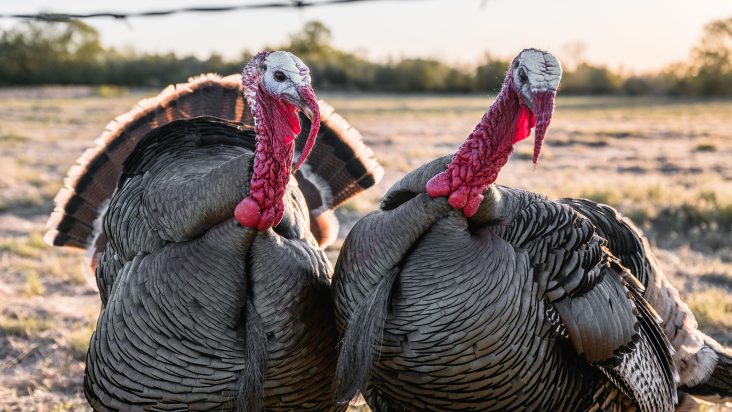
Thanksgiving is synonymous with turkeys.
Each year, millions of Americans gather together around the dinner table to partake in the most iconic of all holiday meals. Yet, turkeys have more to offer than just their role in Thanksgiving feasts. They have surprisingly impressive athletic abilities and unique communication methods, among other things, making them quite intriguing animals. Whether you’re gearing up for Thanksgiving dinner or looking for amusing trivia to discuss with loved ones, here are nine intriguing facts about turkeys that you may not be aware of.
1. Turkeys Have Been Raised By Humans For Centuries
Turkeys have a more extensive historical relationship with humans than one might think. Indigenous peoples in what we now know as Mexico began domesticating these birds roughly 2,000 years ago. They were not initially raised primarily for consumption and archaeological findings suggest that their feathers were greatly respected, used in clothing and ceremonial activities.
Over time, turkeys evolved into a significant food resource, and during the 16th century, Spanish explorers transported domesticated birds back to Europe. From there, they proliferated across the continent before ultimately making their way back to North America with European settlers.
2. Wild Turkeys Are Surprisingly Speedy And Agile
Wild turkeys, despite their seemingly clumsy appearance, actually have pretty remarkable athletic abilities. They can run up to 25 miles per hour (yes, they would be speeding in a school zone) and can fly even faster at nearly 55 miles per hour, albeit in short bursts. This runs in stark contrast to domesticated turkeys, which have been bred to grow much larger and are typically unable to fly. Wild turkeys are the skilled fliers. They can often be seen roosting in trees at night and utilize their speed to dodge predators.
If you ever attempt to chase a wild turkey, don’t expect to catch up with it easily.
3. Benjamin Franklin Jokingly Suggested The Turkey Was A More Respectable Bird Than The Bald Eagle
One of the most renowned historical figures in America had pretty distinct views regarding the national bird. In a letter from 1784 addressed to his daughter, Benjamin Franklin expressed a surprising disapproval of the bald eagle, a true symbol of American iconography. He labeled it as a bird of “dubious character” thanks to its tendency to steal food from other birds.
He then described the turkey as a more respectable bird, also noting that these birds are a genuine American native. Even though he never officially suggested that the turkey should be the national bird, which has often been attributed to him incorrectly, his very interesting remarks contributed to a lasting piece of trivia associated with Thanksgiving in America. Even though the details often get misconstrued a bit.
4. Turkeys Aren’t Only Pardoned At The White House
One of the most well-known Thanksgiving traditions in the United States is the yearly presidential turkey pardon. The Commander in Chief ceremoniously saves two turkeys from becoming someone’s holiday meal each year.
Even though this is the most famous of such ceremonies in the world, there are other places besides the White House where turkeys are given another chance. The notion of a turkey pardon has also been adopted by animal sanctuaries and other organizations. This allows the birds to live out their days without having to worry about being at the center of a Thanksgiving feast.
In addition to bringing a little sense of humor and humanity to the holiday season, these events also aim to increase awareness for the general welfare of farm animals.
5. A Turkey’s Head Acts Like A Mood Ring
Easily one of the strangest things about turkeys is that their heads can actually change color depending on their emotional and physical state. Yes, really. The bare skin on a turkey’s head and neck can shift between shades of red, white and blue.
These color changes are attributed to blood flow and can be triggered by several things, including excitement, stress, as well as other factors. Male turkeys frequently display particularly vibrant colors while trying to attract a mate, in addition to asserting dominance. It’s basically a built-in visual communication system, giving other turkeys clues about how they’re feeling and what they’re signaling. It’s truly not unlike a mood ring, only on a bird.
6. Turkeys Have Been Known To Respond To Music
As difficult as it may be to believe, turkeys have been observed reacting to music and other sounds. It’s not necessarily strange that an animal would react to a loud sound, but while there’s little scientific evidence that they have specific musical preferences, their responses to familiar noises can be quite amusing
Turkeys are naturally curious creatures. They’re known to be social animals that often communicate through vocalizations. Some owners and farmers have reported that their birds gather around while music is playing. Sort of like a little turkey concert.
We may not know whether turkeys have a favorite genre, but it might be fun to imagine them enjoying a little background music.
7. There Are Six Recognized Subspecies Of Wild Turkey
Wild turkeys may look similar at first glance. After all, to most people, a turkey is a turkey. However, there’s more variety than you might suspect. Scientists recognize six distinct subspecies of the bird, each with its own geographic range and subtle physical traits. So, what are they, exactly?
The breakdown goes Eastern, Osceola, Rio Grande, Merriam’s, Gould’s and South Mexican.These subspecies differ in several ways, including feather coloration, body size and preferred habitat. Those details help distinguish wild turkeys across the regions they call home. The South Mexican wild turkey is believed to be extinct, though its legacy lives on. The descendants of these particular birds played an important role in the development of current, domesticated turkeys.
So, in short, they’re the ones to thank for your Thanksgiving dinner.
The turkey’s very distinctive gobble is one of its most recognizable sounds in all of nature, especially during mating season. What may be especially surprising though is just how far that call can travel. According to the Smithsonian’s National Zoo, a male wild turkey gobble can be heard up to a mile away. That’s under ideal conditions but that’s still a staggering distance to be able to hear a bird.
The call is mostly used to attract females and communicate with other males, making it an important part of the species behavior. It’s not just empty noise. Not all turkeys make the familiar gobbling sound though. Males are best known for it, while females typically communicate through clucks, yelps and other different vocalizations.
Happy Thanksgiving!